
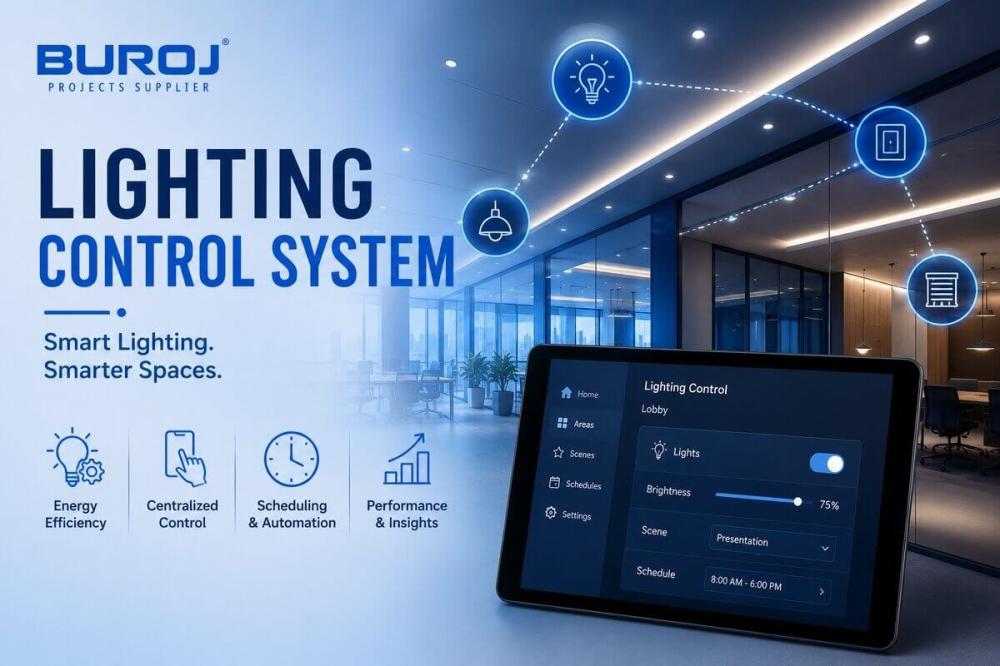
Choosing the right lighting control system is one of the most impactful decisions in any modern building project in Saudi Arabia. A well-designed lighting management system cuts energy consumption by up to 40%, ensures full compliance with Vision 2030 green building targets, and delivers a superior occupant experience in every space it serves. Whether you need a smart lighting system for a luxury hotel or a code-compliant ELV solution for a hospital, El Buroj has the expertise, products, and project support to deliver the right solution.
What Is a Lighting Control System and How Does It Work?
A lighting control system is a network of hardware and software components that manage how and when light sources in a building turn on, dim, change color, or switch off automatically or in response to manual inputs. Unlike traditional on/off switching, a modern lighting management system integrates sensors, timers, user interfaces, and communication protocols to optimize light delivery based on occupancy, daylight availability, time schedules, and scene requirements.
The core components of any lighting control system are:
- Input devices: Occupancy sensors, daylight sensors, manual switches, and touch panels that send control signals to the system.
- Controller or processor: The central intelligence unit that processes inputs and executes pre-programmed scenes or rules.
- Communication protocol: The language through which devices communicate: DALI, KNX, BACnet, Zigbee, or proprietary bus systems.
- Output devices: Dimmable ballasts, LED drivers, relay modules, and actuators that physically control the luminaires.
Lightning control is one of the core components of a complete ELV infrastructure. To explore the full picture of building intelligence systems, read our guide to Low Current Systems in Saudi Arabia covering CCTV, fire alarms, BMS, structured cabling, and more.
Need a customized lighting control solution for your project?
Contact El Buroj's specialists for expert consultation and a tailored proposal.
Contact the El Buroj team via WhatsApp or call 920031298.
Types of Lighting Control Systems
The protocols and technologies available today span from simple dimmer circuits to fully networked intelligent lighting controls that integrate with BMS, HVAC, and AV systems. Understanding the available options is essential before specifying a solution for any project:
DALI System: International Standard for Digital Lighting Control
DALI (Digital Addressable Lighting Interface) is the most widely specified lighting control system protocol for commercial and institutional buildings worldwide. Each DALI device has a unique address, allowing individual control of every luminaire on the bus. DALI 2, the latest generation, extends the standard to include sensors and input devices on the same bus, creating a fully self-contained lighting control ecosystem.
- Up to 64 individually addressable devices per DALI line, groupable into unlimited scenes
- DALI-2-certified sensors for occupancy and daylight harvesting on the same 2-wire bus
- Fully fault-tolerant: individual device failures do not affect the rest of the system
- Ideal for offices, hospitals, retail spaces, and educational buildings
KNX System Integrated Smart Building Control
KNX is the global open standard for building automation, covering lighting, HVAC, blinds, access control, and energy metering on a single bus. As a light control system, KNX offers unmatched integration depth; a single KNX touch panel can control lighting scenes, room temperature, blind positions, and AV equipment simultaneously. KNX is the preferred lighting control system for luxury hotels, premium residential compounds, and large commercial buildings where a unified building experience is the design goal.
- Open protocol: fully interoperable between certified products from 500+ manufacturers worldwide
- Supports up to 57,375 devices on a single KNX installation
- Seamless integration with BMS, HVAC, AV, and security systems via KNX gateways
- Ideal for hotels, luxury villas, large commercial complexes, and government buildings
BACnet Protocol for Large Commercial Buildings
BACnet is the leading protocol for integrating lighting control systems with central BMS platforms in commercial and industrial facilities. El Buroj
supplies BACnet-compatible controllers and gateways that connect DALI and KNX systems with HVAC, access control, and energy monitoring platforms, making them ideal for hospitals, airports, government buildings, and mixed-use projects.
Wireless Lighting Control Systems
Wireless solutions using Zigbee, Z-Wave, or proprietary mesh protocols are the fastest-growing segment of the market, driven by the rapid adoption of LED luminaires with built-in wireless drivers and the need for low-disruption retrofit solutions. These systems eliminate the cost and disruption of additional bus wiring, making them the preferred choice for existing building upgrades, residential compounds, and smaller commercial spaces.
- No additional bus wiring required: ideal for retrofits and heritage buildings
- Self-healing mesh network: devices route signals around obstacles and failures automatically
- Smartphone and tablet control via dedicated apps for hospitality and residential projects
- Ideal for villas, serviced apartments, boutique hotels, and office fit-outs
Benefits of Lighting Control Systems for Saudi Buildings
Investing in a professional lighting control system delivers measurable returns across energy, compliance, comfort, and operational efficiency. For Saudi building owners and developers, the following benefits are particularly relevant in 2026:
- Energy savings 30–50%: Occupancy sensing + daylight harvesting + scheduled dimming = up to 50% less energy vs. conventional switching. Directly supports Vision 2030 targets.
- Green building compliance: LEED, BREEAM, and EDGE award credits for integrated lighting control are essential for developers pursuing green ratings.
- Occupant comfort: Tunable white and circadian scenes improve alertness and productivity in offices, hospitals, and schools.
- Lower maintenance costs: DALI and KNX auto-report lamp failures to the FM team; no manual inspection rounds needed.
- Higher asset value: Certified lighting control systems increase rental value and sale price in the Saudi commercial property market.
A safe and compliant lighting control installation starts with a properly designed earthing system. Read our Earthing Installation Guide in Saudi Arabia to understand the requirements.
Lighting Control Applications by Sector
El Buroj designs and supplies advanced lighting control system solutions tailored to the operational, architectural, and regulatory requirements of every building sector across Saudi Arabia. From commercial offices and luxury hotels to hospitals, warehouses, retail spaces, and large-scale mixed-use developments, each system is engineered to maximize energy efficiency, simplify facility management, enhance occupant comfort, and ensure full compliance with local and international standards.
1. Offices and Commercial Complexes
Offices are among the most common applications for commercial lighting management systems in Saudi Arabia. DALI-2 zoning with occupancy and daylight sensors improves energy efficiency in open-plan offices, while scene-based meeting room controls integrate seamlessly with AV systems. Exterior and façade lighting can also be automated using astronomical time clocks for efficient after-hours operation.
2. Luxury Hotels and Hospitality Facilities
Luxury hotels in Saudi Arabia use smart lighting control systems to enhance ambience, guest comfort, and energy efficiency. KNX systems allow centralized control of lighting, blinds, and HVAC, while DALI/DMX supports advanced scene lighting for lobbies, restaurants, and ballrooms.
3. Hospitals and Healthcare Facilities
Healthcare facilities require advanced lighting control systems that meet clinical standards and MOH regulations. DALI-2 solutions support circadian lighting, surgical lighting scenes, and automated emergency lighting monitoring through the hospital BMS.
4. Warehouses and Industrial Facilities
Warehouses benefit from smart lighting management using occupancy and daylight sensors with high-bay LED systems. These solutions reduce energy use, improve safety, and provide centralized emergency lighting monitoring for SCDF compliance.
Contact the El Buroj team via WhatsApp or call 920031298.
Lighting Control System Comparison: DALI vs KNX vs Wireless
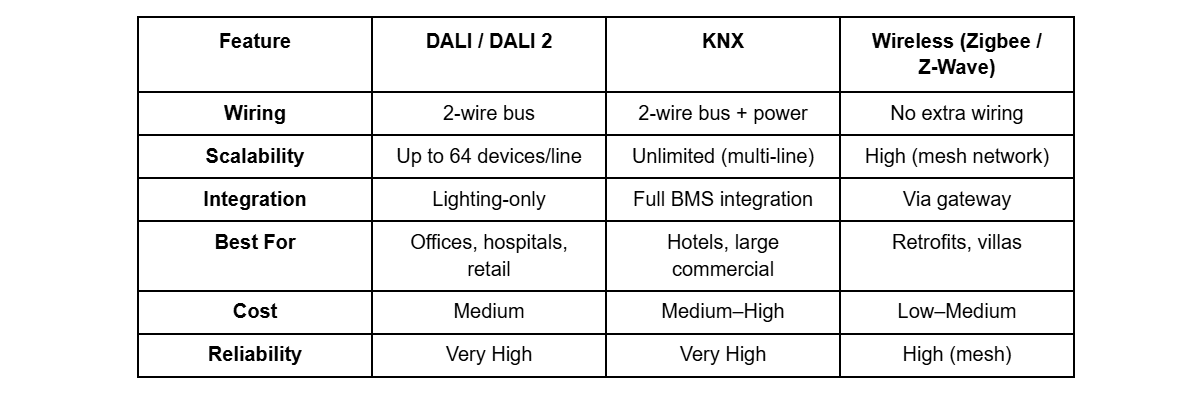
Choosing between the main lighting control system protocols depends on the building type, project budget, integration requirements, and whether it is a new build or retrofit. The table below summarizes the key differences:
DALI / DALI-2
- Uses a dedicated 2-wire communication bus for lighting control.
- Supports up to 64 devices per control line.
- Provides very high reliability and precise lighting management.
- Ideal for offices, hospitals, retail stores, and commercial buildings.
- Offers a balanced solution with moderate implementation costs.
KNX
- Operates through a 2-wire bus system and supports building-wide automation.
- Highly scalable and suitable for large, complex projects.
- Enables full integration with Building Management Systems (BMS), including HVAC, security, and shading controls.
- Commonly used in hotels, smart buildings, and large commercial developments.
- Delivers very high reliability with medium-to-high implementation costs.
Wireless Systems (Zigbee / Z-Wave)
- Require no additional control wiring, making installation faster and more flexible.
- Use mesh networking technology to extend coverage and improve connectivity.
- Well-suited for retrofit projects, villas, and existing buildings.
- Can be integrated with BMS platforms through dedicated gateways.
- Offer high reliability with low-to-medium deployment costs.
Not sure which protocol is right for your project?
Contact El Buroj on WhatsApp, and our engineers will recommend the best lighting control system for your specific requirements.
Top Brands: Legrand, Schneider Electric & ABB
El Buroj supplies Lighting Management System products from the world's leading manufacturers, all of which carry SASO certification and full technical support in Saudi Arabia:
- Legrand: A global leader in electrical infrastructure, Legrand's Valena Life and BTicino ranges provide KNX room controllers, DALI gateways, and occupancy sensors for commercial and residential applications. Their products are widely specified in Saudi hospitality and government projects.
- Schneider Electric: Schneider's KNX-compatible SpaceLogic room controllers and EcoStruxure Building platform deliver end-to-end lighting and building automation integration, from individual room control to campus-level energy management dashboards.
- ABB: ABB's i-bus KNX system is one of the most comprehensive smart building platforms on the market, covering lighting control, blind control, energy metering, and HVAC integration with a certified product portfolio of over 1,000 devices from 150+ manufacturers.
- Osram / Ledvance: Leading supplier of DALI-2 certified LED drivers and integrated luminaires, enabling seamless deployment of addressable digital lighting in offices, retail, and healthcare projects.
- Helvar: Finnish manufacturer with a strong presence in the healthcare and education sectors, offering DALI-based lighting management systems with advanced energy reporting and emergency lighting self-test functionality.
For current availability, datasheet requests, or bulk pricing on any of these brands, contact the El Buroj team via WhatsApp or call 920031298.
FAQs
What is the lighting control system?
A lighting management system is a network of sensors, controllers, communication protocols, and output devices that automate and optimize how luminaires in a building operate. It enables dimming, scene setting, occupancy-based switching, and daylight harvesting, reducing energy use by 30 to 50% compared to conventional switching while improving occupant comfort.
What are the five types of lighting management systems?
The five main categories are: (1) DALI / DALI-2 addressable systems, (2) KNX integrated building control, (3) BACnet-based systems for BMS integration, (4) wireless mesh systems such as Zigbee and Z-Wave, and (5) standalone occupancy and daylight sensor systems for smaller applications without a central controller.
What are the four parts of a lighting control system?
Every lighting management system consists of four core parts: input devices (sensors, switches, and panels); a controller or processor that executes pre-programmed logic; a communication protocol (DALI, KNX, BACnet, or wireless) that links all devices; and output devices such as dimmable LED drivers and relay actuators that physically control the luminaires.
What is an example of a lighting management system?
A typical example is a DALI-2 office lighting installation where ceiling-mounted occupancy sensors and daylight sensors send signals to a DALI controller, which automatically dims rows of LED luminaires near windows when daylight is sufficient and switches off luminaires in unoccupied zones, all manageable from a central software dashboard by the facilities team.
What are the 5 basic elements of a control system?
The five basic elements of any control system, including a lighting management system, are (1) a sensor or input device that detects a condition, (2) a controller that processes the input and applies logic, (3) an output device or actuator that takes action, (4) a feedback loop that reports the result back to the controller, and (5) a communication network that links all elements together.
Request a Quote for Lighting Control Systems from El Buroj
Our engineers will design and supply the right lighting control solution for your project office, hospital, hotel, or industrial facility.
Get instant pricing via WhatsApp or call 920031298.